Gonzalo Bueno Bustíos
Macroeconomic Modeling Specialist
Banco Central de Reserva del Perú (BCRP)
gonzalo.bueno.b@gmail.com · Lima, Perú
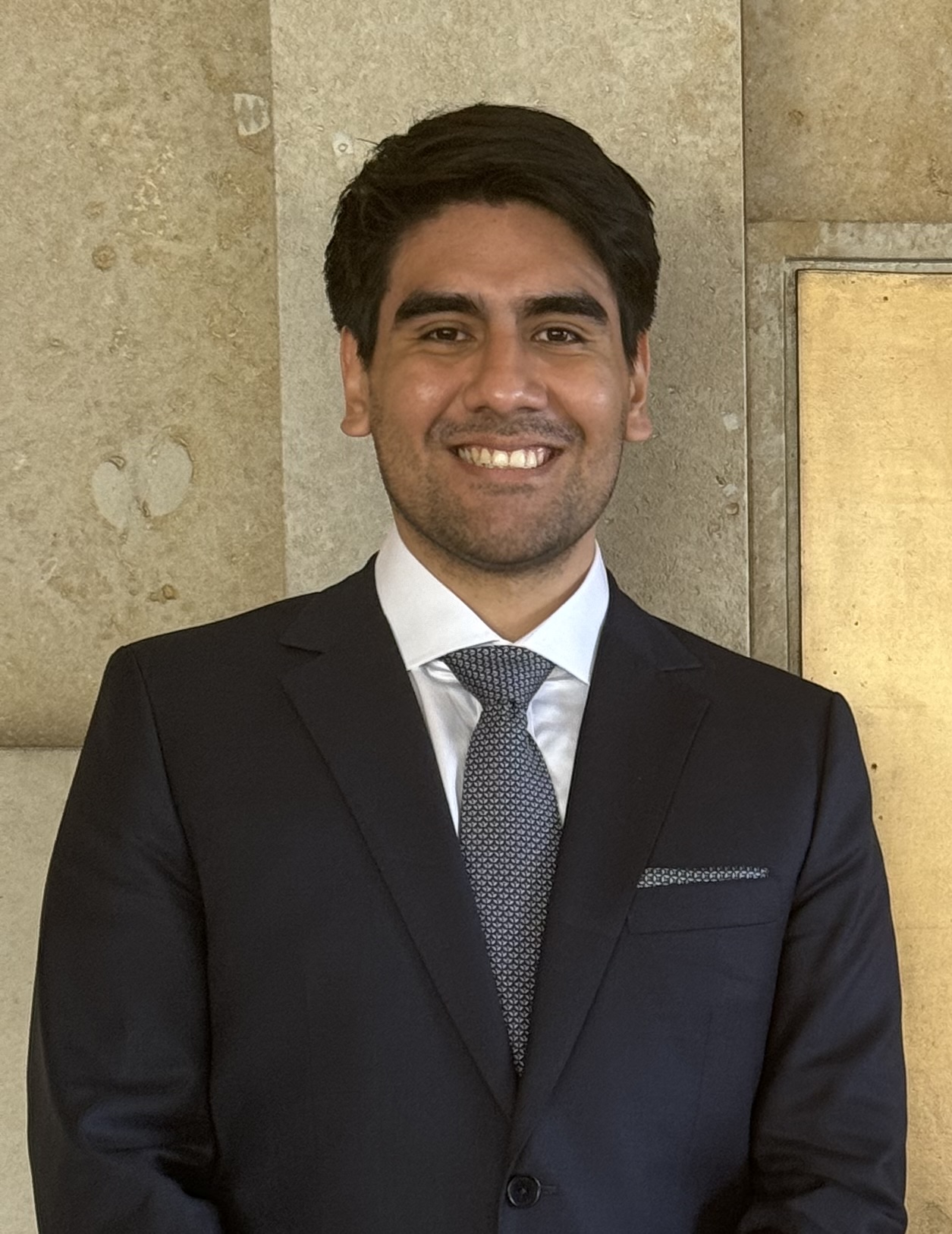
I am a macroeconomist working on international finance and monetary policy in small open economies. My research studies how financial frictions, external shocks and nominal rigidities shape exchange rates, inflation and the effectiveness of macroeconomic policy.
I combine quantitative structural models with empirical methods and granular high-frequency data. I am currently a Macroeconomic Modeling Specialist at the Central Reserve Bank of Peru, contributing to monetary policy projections, structural modeling and policy research. I hold an MSc in Economics (Distinction) from the London School of Economics.
Research
Exchange rate dynamics and policy
I evaluate the BCRP's foreign exchange intervention in the Itskhoki–Mukhin (2026) model, in which intermediaries charge a state-dependent premium for holding currency risk, solved globally and calibrated to Peru over 2002–2025. I quantify how much of Peru's exchange-rate volatility is financially driven and how much of the welfare gain from optimal intervention a simple rule delivers, both on average and during the 2020–2021 stress episode, and compare the rule with the BCRP's observed intervention.
A review of how the segmented-markets literature resolved the puzzle that sterilized intervention should be irrelevant, organized around four policy questions (when intervention works, which shocks it should answer, what it should stabilize, and the role of reserves), with Peruvian data to read the BCRP's practice.
Resumen (ES)
La intervención cambiaria es práctica habitual entre los bancos centrales de economías emergentes, pero el modelo canónico predice que una intervención esterilizada no debería tener efecto alguno sobre el tipo de cambio. Este artículo revisa la literatura que resolvió esa tensión incorporando mercados financieros segmentados, y ordena las reglas de política que de allí se derivan en torno a cuatro preguntas: cuándo es efectiva la intervención, frente a qué choques conviene usarla, qué debe estabilizar y cuál es el rol de las reservas. Con datos del Perú, ofrece claves para interpretar la práctica del BCRP a la luz de estos marcos.
We ask how much the sol appreciates when Peru's terms of trade improve. Using local projections with external instruments over 2002–2025, we show that the terms-of-trade index bundles two different things: the ratio of export to import prices, and their common level. The exchange-rate response comes from the common level, not from the ratio. Most of this appreciation reflects a weaker US dollar against other commodity-exporting currencies, rather than a move of the sol against its trading partners, although a sol-specific effect remains once we control for the dollar. The answer therefore depends on why the terms of trade improve: higher export prices appreciate the sol, while lower import prices show no clear effect.
Financial frictions in small open economies
Price setting and inflation
Using supermarket microdata through Peru's 2020–2024 inflation, I show that firms responded by changing prices more often, not by changing them more: the hazard of adjustment rose while the average size of price changes stayed flat. The evidence points to state-dependent rather than time-dependent pricing.
Abstract
This paper analyzes firm-level price adjustment behavior during Peru's inflationary episode from 2020 to 2024, using high-frequency data from supermarket products. Guided by a simple Rotemberg (1982) model, I distinguish between two margins of adjustment: the frequency and the magnitude of price changes. After filtering out discounts and short-lived price spells, I document a clear upward shift in the distribution of year-on-year price changes, particularly for food items, confirming widespread price adjustment. The price change distribution is skewed toward positive values and bimodal, with few small changes, indicating that firms are more likely to implement sizable price increases than marginal adjustments, in line with the presence of adjustment costs. Hazard rate estimates show that half of prices change within two months, and that the likelihood of price adjustments rose during the inflationary period. Finally, I find that rising inflation was associated with an increase in the frequency of price changes, while the average magnitude remained stable. These results suggest that firms primarily respond to inflation by adjusting prices more often, rather than by raising them more sharply.
Daily price indexes built from web-scraped data follow official inflation trends but reveal what monthly aggregates hide: raw price dispersion is twice the official estimate, and commodity shocks reach their peak effect on processed-food prices 200 to 300 days later.
Abstract
We investigate price dynamics using web-scraped data from supermarkets. We constructed daily price indexes and compared them with official monthly inflation data and studied their reaction to commodity price shocks. To remove noise caused by short-lived price changes, a discount filter was applied to the price series. We compared four characteristics of the official statistics. First, the online price indexes show higher magnitudes of year-on-year variations than official estimates, but follow similar trends. Second, the trends of both price indexes seem to align in the long term, but indexes built out of individual prices seem to deviate for longer periods. Third, the ratio of food to non-food goods prices estimated with online data aligns with official inflation trends but diverges in magnitude for certain periods. Finally, the dispersion of raw prices is twice the estimate in official sources. Nonetheless, we show that aggregation captures relative price adjustments and ignores inner dynamics of price-setting, like coordination. Furthermore, we estimated impulse-response functions to commodity price shocks using a local projection specification. We found that the effect on processed foods tends to peak between 200 and 300 days after a shock. These findings highlight the potential of high-frequency data as an early indicator of inflation trends.
Builds the BCRP's first daily item-level price database, scraped from supermarket websites and classified into COICOP categories. Online price changes peaked later than official inflation but fell faster, and price durations shortened as inflation rose.
Abstract
I analyzed daily supermarket price data from Peru spanning the period of inflation increase from 2020 to 2022, followed by its subsequent reduction from 2023 and early 2024. The Central Reserve Bank of Peru lacked high-frequency price indices to monitor inflation and understand price formation. To address this gap, daily data from web pages of supermarkets was extracted and classified according to the COICOP classification. The findings reveal that price changes peaked later than official data but declined more rapidly. Price changes increased as inflation grew. This resulted in a negative correlation between inflation and duration of prices, which could be regarded as a shift in the inflation regime. Changes seem to be balanced between positive and negative values or biased towards the positive ones, so that variations related to trend prices are larger for increases than decreases.
Using daily supermarket price data from Peru, we identify five patterns of processed-food pricing based on discount-driven volatility and the frequency of regular-price adjustments. The analysis reveals differences across products and package sizes, highlighting how temporary discounts can obscure underlying price trends and how high-frequency data can improve inflation monitoring.
Resumen (ES)
Este artículo realiza una primera exploración a la base de datos de precios de supermercados y clasifica el comportamiento de los alimentos procesados a partir de criterios sobre su volatilidad y frecuencia de actualización.
Other
Tools and Data
An LLM-based system, built on the Model Context Protocol, that lets researchers query the bank's published research and public reports (Documentos de Trabajo, Revista Moneda and Reportes de Inflación) in natural language. The corpus covers all three series. I am finished testing retrieval quality and automatic updates. Next steps are use trials and deployment inside the bank.
Abstract of the working paper
Central banks accumulate economic knowledge across working papers, policy reports and other publications. Accessing this evidence is difficult when documents span decades, languages and formats. I document BCRP Corpus, an independent prototype for searching public publications of the Banco Central de Reserva del Perú (BCRP) and retrieving passages linked to original PDF pages and report editions. The 11 November 2026 snapshot contains 1,441 indexed document records and 96,695 chunks, including 474 working papers, 788 articles from Revista Moneda, 89 Spanish-language Inflation Reports and 90 separately indexed report boxes. A further 465 boxes have searchable catalogue metadata and can be accessed through their parent reports. In a traced bilingual search on exchange-rate pass-through, I recover studies showing attenuation from import to consumer prices and use the original pages to distinguish a rolling long-run estimate from a fixed-horizon response to an externally instrumented shock. The exploratory evaluations document numerical transcription errors, ambiguous evidence and limits of historical reconstruction.
A local-first research knowledge system for how economists interact with academic literature and conduct research with artificial intelligence. It combines reusable academic document corpora, keyword and semantic retrieval, and precise page-level citations, exposed through a Model Context Protocol (MCP) interface that connects research materials with AI assistants.
More
The system preserves original documents and their revision histories, while independent research workspaces keep project-specific evidence, hypotheses, and methodological decisions. The broader objective is an environment that supports the whole academic workflow, from literature exploration and theoretical modeling to empirical analysis, manuscript preparation, and evidence verification, with transparency, reproducibility, and researcher control.
The BCRP's first daily item-level price database: about 500,000 prices scraped from online supermarkets and classified into COICOP categories across 500+ products using machine-learning text classification. It is used for real-time inflation monitoring and policy analysis, and is the basis for the price-setting papers above.
Presentations
- BCRP Internal Research Seminar, Lima2025, 2026
- Seminario de Economía, Banco Central de la República Dominicana2025
- XLII Encuentro de Economistas del BCRP, Lima2024
- 12th Biennial IFC Conference, Bank for International Settlements, Basel2024
- XLI Encuentro de Economistas del BCRP, Lima2023
Experience
- Macroeconomic Modeling Specialist, Banco Central de Reserva del Perú Projections and risk scenarios behind the monetary policy decision (Quarterly Projection Model, DSGE core); built the first Python prototype of the forecasting pipeline. Briefing notes on the natural interest rate for BIS meetings and the Governor, boxes in the Reporte de Inflación, monthly GDP nowcasting. Study leave for the LSE MSc, Aug 2025 – Jul 2026.2024–present
- Price Statistics Specialist, Banco Central de Reserva del Perú Built the BCRP's first daily item-level CPI. Research on price setting reported to the Board.2021–2024
Education
- MSc Economics, Distinction, London School of Economics and Political Science Dissertation: “Is Peru's FX Intervention Optimal? A Welfare Analysis of the 2021 Depreciation”, supervised by Dmitry Mukhin. Funded by a BCRP study-leave scholarship.2026
- Advanced Economics Extension Course (postgraduate level), BCRP2021
- BS Economics, Universidad del Pacífico 2020
Teaching
- Teaching Assistant, Monetary Policy, BCRP Advanced Economics Extension Course2025
- Teaching Assistant, Universidad del Pacífico: International Macroeconomics, Macroeconomics II, Econometrics I, Mathematics III–IV, Intro to Microeconomics2018–2023
Honors and Awards
- Selected participant, Topics in Monetary Economics (PhD-level central bank course), Study Center Gerzensee2027
- BCRP Study Leave Scholarship, MSc at LSE2025
- Employee of the Year, Information and Economic Analysis Division, BCRP2022
- Second Place, BCRP Innovation Award2022
- Letter of Recognition for Merit, President of Universidad del Pacífico2017